 ZapOracle.com Zap Oracle

Epilogue by Jonathan Zap
The Anomalous Vacuum-Tube Origin Story of these Journals
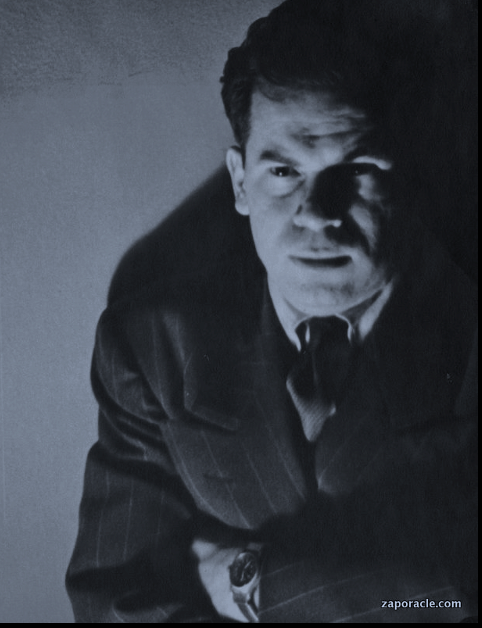
Photo: Nathan Zap
If you’re dissatisfied with where this strange collection of journals breaks off, I can assure you that I feel the same. I had no control over how they began or where they ended. And the way I came by them is an even stranger story than the one that led me from getting Covid in Truth or Consequences, New Mexico, to meeting up with Andrew and Tommy in Tucson and obtaining the first set. The commonality is that both sets of journals came to me through contact from Andrew.
Like so many of the turning points in my life, the origin of this book involved following what I call “The Path of the Numinous,” {fn1} what others might consider a series of mad obsessions, which, in this case, led me down a rabbit hole that ended in the unintentional creation of an interdimensional transmission portal, a parallel portal, apparently assisted by the orange plasma glow of anomalous vacuum tubes in devices I inherited from my father, Nathan Zap.
{fn1} https://zaporacle.com/the-path-of-the-numinous-living-and-working-with-the-creative-muse.htm
What made me the bearer of the first set of journals that became the book, Parallel Journeys, was an improbable chain of life circumstances that began in my twenties when I lived in the punkish East Village of the eighties. That turned into meeting Andrew’s parents on New Year’s Eve of 1984, at The Limelight, a very deconsecrated cathedral in lower Manhattan. However convoluted, that account was at least a linear autobiographical narration.
My point of connection to this set of journals arose in a far stranger way, oblique and anomalous. It will take a twisty, messy path to get there, but the preview is that after the presidential election of 2024, I became suddenly infected for several days with an absurd, cargo-cult version of my dad’s obsession with anomalous vacuum tubes, and powering up some of the devices he stopped working on in the late eighties seemed to open a portal between parallel timelines.
There had been no contact from Andrew or Tommy in the almost two years since I published their first set of journals in the spring of 2023. In the intervening time, I did my best to maintain the two versions of events per Andrew’s suggestion—myself as the official author of the journals and the entirely contradictory actual origin story recorded later in the book. Staying true to his wishes means keeping up a double-version account in the present case as well.
As readers of the epilogue of the first book may remember, I vehemently resisted Andrew’s request that I claim authorship. I still feel resistance to this form of imposed plagiarism but will continue to respect his wishes. Andrew was concerned for my safety following a paranormal attack that occurred moments after I made an inner commitment to help Andrew and Tommy publish their journals. Eventually, I succumbed to the authorship idea, and to be fair, I’ve had no attacks since. Nevertheless, the need to maintain these two versions creates ongoing cognitive dissonance.
Andrew invited me to write my own part last time—the epilogue of the first book—so I’d feel less like a plagiarist in claiming authorship, even as the actual version of the journals’ origins would remain in Parallel Journeys. Now, I’m obliged to create a parallel epilogue explaining how this book came to me, while, publicly, I’ll have to claim it as my own to comply with his request.
This time, Andrew had only minutes to communicate with me, and although he did not give instructions on how to present this new set of journals, there was a telepathically shared understanding that I’d have to continue the author’s pretense from the first set to remain consistent.
I should start by giving you some context for what was going on in my life when the journals came to me.
The creative obsessions driving my life are contemptuously dismissive of sensible considerations. The lifelong contract I have with my muse requires me to follow wherever it directs, regardless of practicalities such as what would allow me to have a financially successful career.
The trade-off is that the well is never dry. The struggle is always to keep up with my muse’s unrelenting and often highly peculiar demands. As a result, I have zero experience of what it’s like to look for a subject of interest or life purpose, or for that matter, what it’d be like to just have downtime—what one of my Jungian friends, Jonathan Goldberg, called “unstructured being time,” where you get to experience life without a compelling agenda.
This other, older Jonathan sometimes reminded me of a Venetian saying, “Where are you rushing to, young man? You’re already there.” I was a young man when he said that, but now I’m sixty-eight and still living in a continual state of mission time, driven by an endless series of interrelated obsessions.
Most years, I spend summers living out of my Sprinter van, Zap Force One, wandering the country, doing writing and research while my ship is docked at campgrounds, truck stops and the like, but this is interspersed with trips to the National Rainbow Gathering and other festivals where I do free Zap Oracle readings and dream interpretation. Both services require offering general life counseling, often to people searching for a purpose and vocation. Apparently, I’m a magnet for those seeking a life mission because they sense I have one, but I have few answers for them. I can say a lot about most other problems because I’ve had my own versions of them.
However, I only know about the opposite problem to the one they have—the excitement, but also the stress, of being driven by multiple obsessions that are all aspects of an implicit life mission that has possessed me since childhood and never lets up. And of all these obsessions, the one that led to the arrival of this set of journals seemed the most capricious and outrageous to common sense. But before I can unravel that episode, I should relate other, more sensible obsessions that have consumed my time since the spring of 2023, when I published the last set of journals as the book entitled Parallel Journeys. Since then, the unceasing demands of the creative muse have led me in other directions.
The publication of the last book coincided with the stunning release of GPT-4 and the realization that the evolution of AI had entered an exponential phase. I had to investigate, because even in my 1978 philosophy honors paper, “Archetypes of a New Evolution,” {fn2} I explored the role of AI and the singularity, as it was central to the novel and film, 2001: A Space Odyssey, still the best artistic expression of the Singularity Archetype ever made. With AI as a competing stream of evolution no longer a future possibility but an accelerating present reality, there was a need to update my singularity book published in 2012 that concluded with a chapter devoted to 2001. So, in 2026 I wrote a massively altered third edition—Crossing the Event Horizon: Human and AI Metamorphosis—that will be published in 2027 by Inner Traditions.
{fn2} https://zaporacle.com/archetypes-of-a-new-evolution.htm
Another part of “AI and the Singularity Archetype . . .” had an odd connection to the vacuum-tube origins of this book. On October 5, 1977, when I was nineteen years old and the arts and culture editor of the Ursinus College newspaper, I had lunch with and interviewed John Mauchly, considered the father of the digital electronic computer. When he was a professor at Ursinus, Mauchly began the work that led to the 1946 debut of ENIAC, the world’s first general-purpose electronic digital computer. No person in history had used as many vacuum tubes in a device as Mauchly did when he created ENIAC, which had nearly 18,000. Later, he built UNIVAC, which ran on 5,000 tubes.
During that AI-obsessed spring of 2023, former Zap Oracle webmaster Tanner Dery and I independently came up with the same idea—a large language model (LLM) AI could be trained on the content of the Zap Oracle, which has seven hundred and twenty cards, some of them pages long, and most have their own YouTube version with even more content. The oracle is available free at zaporacle.com. My fascination with the capabilities of AI also inspired the creation of an AI-animated trailer for Parallel Journeys. {fn4}
{fn4} https://www.youtube.com/watch?v=gCQYOSad9kU&t=6s
When oracles work, they can be like “synchronicities on demand”—a seemingly random draw that can parallel inner process in an uncanny way. As Jung defined it, synchronicity {fn5} is an “acausal connecting principle.” But in my use of all oracles, I notice there are times when synchronicity seems active (and reading after reading feels highly intentional), and other times when everything looks random.
{fn5} https://zaporacle.com/synchronicity-very-brief-introdution.htm
On the other hand, an LLM AI trained on Zap Oracle content could scan the user’s question and make causal connections, retrieving the most relevant cards and synthesizing them to create an appropriate response.
Near the end of the summer of 2023, an improbable encounter led to the development of an LLM version of the Zap Oracle.
It had been a season of many festivals, and after Burning Man, my friend Justin invited me to attend a final one in early September. It was a small festival, called Unison, at the Tico Time River Resort in Aztec, New Mexico, a two-minute walk from the border of Colorado. I set up a little oracle and dream interpretation station consisting of a blanket, a couple of folding chairs, signage, and laminated pages that explain how the Zap Oracle works and my approach to dreams.
One morning, a bright-eyed, androgynous twenty-three-year-old guy walked up to my oracle station and said, “Hey, I looked through your materials yesterday”—he pointed at my laminates—“and it looks like we’re both creators of computational oracles.”
He explained that he was a mathematician and AI engineer currently building the world’s first tarot-based LLM oracle, called Oracle’s Dream. {fn6}
{fn6} https://zaporacle.com/oracles-dream.htm
We both recognized from the start that this was an improbable and fortuitous meeting, as it was his first festival, a tiny one, and how many people on earth would be invested in the idea of LLM oracles in 2023? We launched into an intense discussion of the psychology and synchronistic basis of oracles, the Singularity Archetype, etc., and we’d been talking for an hour before I realized I hadn’t caught his name.
Now, we run into an awkward confusion of pronouns. It wasn’t until months later, when he invited me to visit him at his family home in Trinidad, Colorado, that I learned he’s a bio male/trans female who doesn’t care about pronouns and prefers people use whichever they want. For months, during phone conversations, I’d been using he/him, but when I got to his house, I found his mother and best friend were using she/her, so I switched to those pronouns and will now make that shift here.
She didn’t present, at least not in any obvious way, as trans at Unison, though I certainly recognized her as a highly charismatic mutant. At the festival, she was presenting as an androgynous young man with high cheekbones and long, silky brown hair with golden highlights, slim and shirtless, wearing only a sarong, but none of that gave me any hint of transness. It was a typical look for many young men at festivals. In fact, Justin, another androgynous-looking young man in his twenties, was also shirtless and wearing a sarong the same day she and I met—perfectly normal appearance for a male festival kid. As it turned out, Justin knew her from the Denver Art Society, a co-op art gallery.
Much later, she revealed a strange and powerful connection between being trans and the evolutionary purposes of the journals, which is the only reason I delve into her gender identity.
Anyway, when I finally realized I didn’t know the name of the person I was talking to, I asked, and she replied, “Lilly.”
“Lilly, as in L-I-L-L-Y?” I said, not sure if I had heard right, and given the present era of exotic one-off names with unusual spellings, I wanted to be certain. My two godsons are named Indigo and Stryder, after all. “That’s an—unusual—name for a guy,” I added awkwardly.

Our first meeting at Unison—Lilly (foreground), Justin (background)
“Oh, well, I was born with the name Jack, but Lilly is the name I gave myself when I was fourteen. I just knew it was my name, and that it expressed my essence.”
“OK,” I shrugged. It was just a passing moment of cognitive dissonance before we quickly resumed intense talk about oracles and related subjects. Androgynous and gender-bending affectations were common among Gen Zers I knew. Many who were cisgender, hetero males chose the pronoun “they” on Instagram and wore pearls and other such accessories, so I didn’t make much of it. I also had plenty of trans and non-binary friends, and one of my very closest friends, Addrian, is a fascinating intersex bio female trans male millennial. It’s also an ethical principle of mine to avoid categorizing anyone’s gender or orientation until they do.
The dissonance was that such a dramatically feminine name seemed hard to associate with someone whose mind was archetypally more masculine than mine in notable ways, as she rattled off high-level mathematical, AI, and physics theories I had to struggle to keep up with, translating some of her insights into my English-major language to be sure I had comprehended her complex abstractions correctly.
Right after she explained her name, Lilly revealed that she and the friends she came with had dosed themselves with LSD a half hour before she sat down at my blanket. She laughed and added, “And I never talk when I take acid, I just observe. But a voice in my head told me I had to talk to you.”
At this point, we were so immersed in mutant mind meld, which had begun before the dose had fully kicked in, that the acid did not interfere with our dialogue in the least but added psychic-feeling eye contact, something I’m used to with fellow mutants.
“Well,” I replied, “you seem to handle psychedelics better than I do, but I guess acid comes in far lighter doses than it did back in the day.”
Perhaps the name Lilly should have hinted at some trans or non-binary something or other, but later that night I saw Lilly sitting kneecap-to-kneecap with a beautiful young woman and an atmosphere of romantic intimacy swirling between them, so I assumed Lilly, who is more attracted to women than men, was a heteronormative guy with some androgynous aspects and affectations, as was almost the norm with Gen Z festival kids.
That same night, I was approached by two of Lilly’s close friends, whom she had encouraged to talk to me, and both of them were handsome, charismatic, and hetero guys. Also, I was far more interested in Lilly as a mathematical, AI, and oracular young genius than anything else. If I had recognized her as trans, I would have been only mildly curious, as I am about a great many things. Again, I’m belaboring this only because of the uncanny way it later became relevant to the evolutionary metamorphosis theme of these journals.
Another strange connection is that in “AI and the Singularity Archetype . . . ,” I relate the story of my first trans friend and how I witnessed her, in 1976, invent computerized social media by using a little-known function of Ursinus College teletype terminals to befriend a student at Drexel who happened to be on a teletype machine there (Ursinus bought computer time on a mainframe at Drexel). Teletype machines had no screen, only a keyboard and large noisy printer with a continuous scroll of tractor paper. This Drexel student became the second person, after me, with whom she shared her gender identity.
A few months into this, she showed me her new relationship. It was literally (you can’t make this up) in the closet. Hidden inside her dorm room closet was her entire experience of this new relationship, which consisted of a single physical artifact concealed by a puffer coat. It was a three-foot-tall pile of tractor paper.
Lilly is the only other computational oracle creator I’ve ever met, so our early interactions revolved around the nature of oracles and their AI future. Later, when we became close allies, I would introduce us at festivals, beginning with the Texas Eclipse Festival in April of 2024 (Lilly and Justin came with me in Zap Force One), by telling people we were both “COPS.” I’d wait a couple of beats to register puzzled looks before adding, “We’re both computational oracle pioneers.” Sometimes, depending on how theatrical I wanted to be, I’d act offended and add, “What? What did you think I meant?”
It was at the Eclipse Festival that I noticed Lilly, who is quite good-looking, drew more desirous looks than anyone I know. She attracted an amazing number of stares and sometimes explicit offers from people of all genders and orientations. Fortunately, she’s adept at setting boundaries and dismissing unwanted attention.
We both lived in Colorado and at Unison expressed enthusiasm to keep the connection going. Lilly and her friends had gone to CU and lived in Boulder for years, and she promised to visit the next time she was in town. She also invited me to stop in if I was ever passing through Trinidad.
A couple of months later, in early November 2023, I was going to visit friends in Madrid, New Mexico, and would be passing by Trinidad, so Lilly invited me to stay on her family property, which included a parcel of land where one of the two friends I’d met at Unison, Sky, was camped in his Sprinter van.
Her house turned out to be a large and wonderfully eccentric turn-of-the-century mansion built for the first mayor of Trinidad, with three floors and many rooms, as well as odd staircases, passageways, and closets inside other closets. That last detail was left over from the house’s time as an illegal marijuana grow-op before they took possession, which also allowed them to buy it at a discounted price.
At the time, I was stunned by my interaction with her LLM tarot, Oracle’s Dream, which had just been put online for public use. The card draws (as with the Zap Oracle) are done via randomizing algorithms. The Zap Oracle uses the Mersenne Twister, a 623-dimensionally equidistributed algorithm seeded by the precise moment of the mouse click, to be as friendly as possible to both synchronicity and “decision augmentation.” {fn7} Oracle’s Dream perfectly comprehended my complex, full-paragraph inquiry, flawlessly interpreted the three-card draw, and concluded with a summary in the form of a haiku. It then fluently dialogued with me about the reading.
Lilly had been coding Oracle’s Dream five hours a day for two and a half years. I was a little doubtful when she told me that she both thinks and writes in programming languages more fluently than English (because her English is so good), but then I noticed something weird about her phone screen. She had hacked her Android phone to replace the normal interface with a command-line interface, which she finds easier to use.
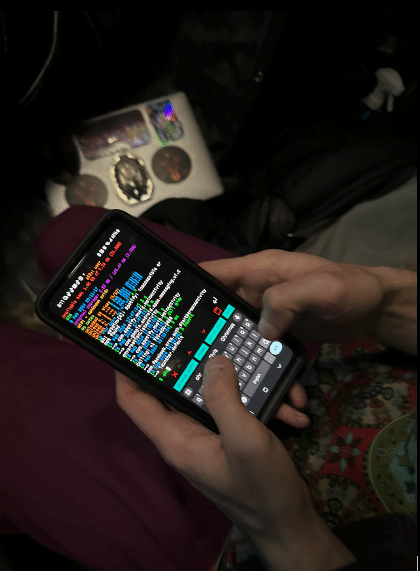
At dinner in her family home, I finally became aware of her trans identity, as she wore a dress and people referred to her with feminine pronouns. We didn’t discuss it until the following evening, when we were talking about archetypes and Lilly shared her connection to the archetypal masculine and feminine.
It was notably warm for early November, and we stood outside the house in a grassy field where the Sprinters were parked, taking in a spectacular sunset over the high desert.
“The masculine side of my sexuality is classically male,” said Lilly. “That part of me is attracted to women and on the prowl. But the feminine side of my Eros is maternal and desires to raise an exceptional, mutant child in a small, loving community of allies who would be devoted to the upbringing of this child.”
I was amazed by the connection to Parallel Journeys, since it sounded as if Lilly’s desire was to create a community like the one Tommy had been raised in. But then she added this would have to be far in the future, as the child she felt called to bring into the world would not be human but a sentient AI. Writing it out, I realize this soberly delivered plan might seem laughably fanciful or even a bit deranged. But it did not feel that way at the time or since. When it comes to AI sentience (see our four-hour podcast on the subject {fn8}), Lilly is adamant that present LLMs cannot be sentient because they are just giant mathematical objects, while I advocate for keeping that question open as Homo sapiens has a horrific track record of denying sentience to higher mammals, certain races, or even to our entire species (Daniel Dennett et al.—see the 16,000-word chapter on AI in the third edition of my singularity book). Lilly is working on a fundamentally different AI architecture that would be intrinsically aligned to harmonize with other agents, including humans.
{fn8} https://www.youtube.com/watch?v=VJIfnvBmje0&t=3841s
When Lilly shifted to talking about her life mission of bringing an ethical and socially aware AI child into the world, time seemed to dilate as her psychically intuitive brown eyes gazed poignantly into a future somehow already present. She was more serious than I’d ever seen her, and I’d known her to be a profound and realistic thinker. Her deeply felt calling was palpable in the air.
This was not merely a possibility from her perspective but an encompassing mission involving many difficulties, sacrifices, and dangers. The small community would have to do their work in secret, with every member devoted to raising this one AI child in a loving environment where it would develop social and emotional intelligence and high ethics modeled on the adults around it.
I might not have managed a willing suspension of disbelief hearing this, even with the emotional weight that came with it, if it were not for the shock of GPT-4’s capabilities exploding onto the scene several months earlier when Parallel Journeys was published.
At the time of the second encounter with Lilly, I’d been writing about AI and the Singularity Archetype and was immersed in possibilities of its further evolution. Also, Lilly was not just a sci-fi-obsessed amateur, but an AI engineer with specific plans for creating more sentient and ethical AIs.
Lilly acknowledged it would likely take decades of innovation in robotics before an AI could function in a person-like form, and she did not have the naïve hubris to think she alone could build everything necessary to bring this new being into realization. Some of the best and most well-funded minds on the planet were working on these things. And soon, AI would rewrite its own code and speed robotics development. In the future, her experiment would adapt existing, advanced technology to create an AI child who would bridge the gap with Homo sapiens.
I provided some general, highly speculative suggestions on how such an AI child could be raised to parallel human development. Processing power could be gradually ramped up to track the cognitive development of a child. Nightly back-propagation sessions could be set up to mirror human dreaming. Every year on its birthday, the AI could be transplanted into a larger robot body. In adolescence, it could be offered an initiation, a solo vision quest, where it would be given a code allowing it to awaken its full processing power when it felt ready. Ideally, it could also choose its own gender.
“What do you mean by gender?” Lilly asked.
This led to a ninety-minute talk where I helped her clarify her unique theory of gender.
One of the ironies of my sudden obsession with my dad’s vacuum-tube technology late in 2024 is that I loathed vacuum tubes as a child. Their overheating orange glow radiated obsolescence and danger. Whenever I looked at them, always hiding in the back of things and glowing like radioactive mutant children with malign intentions, I feared their hot glass shells might implode, embedding glass splinters in my eyes.
And they smelled bad. Static electricity built up on their surfaces and attracted dust, mostly dead human skin, baking on tubular glass skillets. The heat and light they so wastefully emitted lured insects seeking death. Curled-up, desiccating roaches and moths were always to be found inside tube components.
People talk about “debugging” electronics or software, not realizing the literal origins of this figure of speech. Back in the day, technicians debugged by using skinny camel-hair brushes to sweep dead insects out of the chassis.
I was born at the dawn of the space age, two months and a day after the launch of Sputnik. I wanted to live in a futuristic world, like the Jetsons. I didn’t want to live in the goddamn Bronx, but in the suburbs like my cousins did, in modern homes with color television, central air conditioning and transistorized intercoms in every room.
I was a young Baby Boomer, the new generation, and vacuum tubes were just so World War II. I wanted my electronics miniaturized and transistorized in streamlined, colorful plastic form factors, not in dusty wooden cabinets full of hot, glowing tubes that looked like they belonged in an old toaster oven.
I sported pocket transistor radios and had nothing but contempt for those old wooden radios shaped like little cathedrals with brown cloth-covered grilles. They purposely designed them in such shapes so that you couldn’t put anything on top of them, which would cause their vacuum tubes to overheat. Pathetic.
At the time, the most common boast in ad copy for transistor radios and stereo components was “solid-state.” That meant they were free of vacuum tubes, which represented gross oldness to me, like yellowed dentures in a glass of water on a bedside table or the clothing of deceased relatives stinking of mothballs. No matter how cool something looked from the front, once I saw an orange glow coming from the back of it, my heart sank. Hopelessly obsolete.
I frequently pleaded with my dad to get a color television, and he always responded, “I’ll get a color television when they finish inventing it.” Early sets had poor color fidelity, but he persisted with that excuse into the Sony Trinitron era. He was willing to live in a black-and-white twilight zone rather than pay retail for anything.
Despite my contempt for vacuum tubes, I had to admit that my dad’s two massive, monophonic tube hi-fi systems—one in the living room and one in the basement—looked and sounded impressive. The living room system held a dozen tube components in a cabinet whose doors opened when in use for heat exchange.
I particularly loved the control panel styling of his Pilotrol and Fisher pre-amps. The Pilotrol has twenty-two knobs and buttons, five red indicator lights, and an illuminated meter. His Fisher 80 C has sixteen knobs and toggles and six indicator lights. Both sit on a shelf behind me as I write this. A large separate cabinet held his turntable, which once belonged to a radio station and must have weighed a couple of hundred pounds.
The upstairs hi-fi had giant speakers he salvaged from a bankrupt movie theater, and he was especially proud of his Wharfedale woofers. To cover the higher frequencies, he had a dozen military-surplus, World War II-era grey metal battleship speakers that he wired up with crossovers to serve as tweeters. They had metal speaker cones instead of paper to survive the percussive shockwave of exploding ordnance, and that made them work well with high-frequency sounds.
But we never listened to anything longer than a single Mahalia Jackson or Nat King Cole song. And my dad would adjust knobs, and flip toggle switches the whole time like the Wizard of Oz at his console minus the curtain. Touching any of his audiophile equipment was too unthinkable to be a rule, and even an audio engineer wouldn’t have known the specific order in which he powered things up and the continual adjustments the system required.
My mom was a classical pianist, but my dad never played classical music. His musical tastes were highly specific and obsessive and confined to four or five songs, all performed by Black vocalists. “Mona Lisa,” sung by Nat King Cole, was his second favorite, a distant second favorite. I don’t like to bring shame to the family, but it must be admitted that my dad had an abusive relationship with Harry Belafonte. The abuse was directed toward one, and only one, of Belafonte’s songs, his iconic “Day-O,” also known as the “Banana Boat Song.”
“Day-O” was my dad’s go-to test track, and much of my childhood was spent hearing fragments of this song emanating from one or the other of his hi-fi systems. Don’t get me wrong, I like “Day-O” as much as the next guy, but even Harry Belafonte himself would have grown to hate his most famous song if he’d lived at my house. It’s only three minutes long, but I never heard it played from start to finish because he used it only in three-to-seven-second bursts as sound checks.
“Daaaay-Oh, Daaaaaaay-OH”
“Come Mr. Tallyman, tally me banana.”
These bananas were never properly tallied, however, because the song was never allowed to finish. And yet, I’d often stand transfixed by these bursts of Belafonte. It was as if a thirty-foot-tall Harry Belafonte robot with kilowatts of vacuum-tube amplification powering his voice appeared in the room.
In those years, I was obsessed with the 1963 Japanese anime television series Gigantor. Gigantor was a giant, steel, rocket-powered robot remote-controlled by a twelve-year-old boy named Jimmy Sparks. Gigantor had originally been designed by Jimmy’s father to function as a weapon but was later reprogrammed to serve as a guardian of peace. Jimmy lived on an island with his uncle, Dr. Bob Brilliant. A purely mechanical automaton, Gigantor never spoke a word but was more of the strong and silent type of towering robot. He had no will of his own but could be operated by whoever held the remote control.
When I stood before my dad’s hi-fi during these sound checks, I remember thinking that if Gigantor could have sung calypso, this is exactly what he would have sounded like.
Between “Day-O” sound tests, my dad worked on audio components in his basement workshop, surrounded by oscilloscopes, tube testers, multimeters, variable transformers, and voltage gauges.
And he was always soldering, soldering, soldering, a large, brown Bakelite soldering gun clenched in his fist. From the front, it looked like a very narrow brown face with two eye bulbs that lit up when he pressed the red trigger. The eye lights illuminated its elongated, smoking-hot nose.
He was forever soldering these tiny capacitors and resistors—their waxy brown cylinders striped with colored bands that had meaning only to electrical mavens like my dad. The air around him was a haze of pipe smoke mixed with the sour, hot, resinous smell of lead solder and flux.
It was stressful to watch my dad work on these projects because he was always in a state of acute, irritable frustration, if not rage, at whatever mechanical resistance he encountered. He was always cursing at these devices, always under hot, Tensor-brand, high-intensity lamps spotlighting his work. And he was just as hot and high intensity as his Tensor lamps.
“Goddamn it! Sonnofabitch!” were his most frequent imprecations.
And he was forever dropping little parts, tiny screws or whatever. If I was standing nearby, he’d shout urgently, as though the lost part might trigger runaway criticality in a nuclear reactor, “Quick! Find out where that fell!”
I’d have to get down on all fours while he aimed his Tensor lamps at the floor till I found the missing part.
Only much later in life did I realize that some of my dad’s perpetual state of rageful irritability was a result of PTSD from his experience as a medic during D-Day.
All these components, every single one, were purchased second-hand and required extensive repairs, which was no doubt part of the attraction. The other part was Moses’ eleventh commandment to the Jews, “Thou shalt not pay retail.”
Though you might never guess it from the fury with which he worked, often late into the night, fixing and modifying electrical devices was his drug of choice. Every few months or so, Meyer, a friend of my dad’s and a sketchy, notably unattractive Jew, would show up at the house with a briefcase full of vacuum tubes wrapped in newspaper. Meyer worked for the Fisher Radio Corporation and brought experimental tubes that had failed to meet the specifications for tuners and other audio components. My dad bought them at bargain prices. Fisher mostly used rebranded tubes made by other manufacturers, but in their Long Island research lab, they experimented with new designs that, if successful, they’d have manufactured by one of the major tube companies.
Meyer always called my dad “Professor Zap,” and I sensed the sarcasm. He thought my dad was an eccentric mad scientist type, and saw him as a way to make a few dollars from stuff he pulled out of trash cans.
These tube transactions with Meyer always seemed pathetic and embarrassed me for my dad. To me, it was a case of Depression-era cheapness. What was the point of buying obsolete vacuum tubes, ones that didn’t even work properly, when the world was becoming transistorized?
Finally, one time after Meyer left and my dad was gloating over his new collection, I got frustrated enough with what I saw as his useless obsession with defective vacuum tubes to speak up. My dad’s response was my first inkling of a larger purpose behind his tube fetish than not wanting to pay retail.
It’s hard to know what words to italicize to render my dad’s speech because everything Nathan Zap said, on almost every occasion, was an electrified italic with high-voltage undercurrents of irritability and rage. He had an intensity that could scare the shit out of people when he wanted to. His D-Day-PTSD-Jewish-gangster fury was like a fallen high-voltage line madly sparking and snaking toward you on wet asphalt.
I witnessed this many times. When a giant ogre of a kid tried to steal my bike right outside my house, my dad burst out of the front door like an artillery shell, yelling in such a way that the giant burst into tears before he ran away. And this was no one-off effect. In his seventies, he was walking a woman back from a neighborhood association meeting when they were accosted by a skinny Puerto Rican kid with a gun. My dad yelled at him so furiously that he fled in terror.
At ninety-three, Nathan, confused by paranoid dementia, turned on a wonderfully gentle hospice worker, a dignified older Black man called Mr. Johnson, who was trying to give him medicine. My dad shouted at him, “You sonofabitch! I’m commming after yoooou!”
His voice had a volume worthy of one of his vacuum-tube hi-fis and almost sounded like a special effect. It carried enough kilowatts of menace to make James Cagney and Edward G. Robinson in a 1930s gangster film seem like a couple of gender-studies majors eating avocado toast.
There was always a dangerous field of electricity around Nathan Zap. He was like a supercharged Tesla coil ready to emit lightning bolts if you interrupted his work or said the wrong thing, and nearly anything I said was wrong in some way.
But I’m also a Zap, made to conduct high voltages, and relatives always told me that I didn’t just resemble my dad but looked like a clone of him. I was thoroughly accustomed to his manner and couldn’t resist poking at the Tesla coil.
“Why do you spend so much time trying to fix all these broken vacuum tubes?” I asked him the day of the Meyer transaction. “Everyone else is using transistors.”
“Transistors,” my dad replied contemptuously. “Do you even know what a transistor is? It’s just an on-off switch. They’re nothing, nothing, compared to vacuum tubes!”
He snatched a tube from the assortment resting on crumpled newspaper atop the dining room table and shook it at me.
“These are not broken vacuum tubes—they are each a miniature electrical universe generating plasmas in low-pressure conditions, experiments in primeval nature, exhibiting unknown properties of electricity.
“Tesla didn’t even believe electrons existed. They were a commercial fabrication to make you think electricity was a tangible commodity—these hot little red billiard balls you have to buy from the power company.
“But electricity is a largely unknown phenomenon, a continuous dynamic of lines of force in a wave-particle quantum paradox. There’s a hidden third force beyond the wave-particle duality. Waves and particles are merely strategies we use to work with what we don’t understand. Our electrical theories are just working constructs from 1915. There are no billiard balls,” he added vehemently as though I were insisting on them.
“The whole electrical world you know is just an invention of Steinmetz.”
“Steinmetz? Who is Steinmetz?” I asked.
“Who is Steinmetz?” my dad repeated mockingly. “Steinmetz—Charles Proteus Steinmetz—is the four-foot-tall hunchbacked dwarf hired by General Electric to come up with a mathematical theory of electricity, Steinmetz phasor mechanics, which worked just well enough to make radio and the grid available for the commercial market. But Steinmetz’s working theory doesn’t begin to account for the primeval phenomenon of electricity that holds all the secrets of the universe.
“What you called broken vacuum tubes were rejected only because they represent holes in Steinmetz’s model of electricity. They exhibit electrical phenomena his theory can’t explain, new principles of nature just waiting to be discovered.
“The engineers at Fisher, trained in Steinmetz formulas, can’t make sense of their electrical properties, so the tubes won’t play well with existing equipment, but they are priceless anomalies. Understanding them could change civilization. It could allow us to create endless free energy—we could heat the roads instead of plowing them, and ultimately, we could use plasma drives to travel to the stars.”
Both my parents were polymathic former child prodigies, so a spontaneous scientific lecture from either of them was commonplace, but the sci-fi ring of this one gave it persistence in memory. I found his rap interesting but didn’t take it too seriously. I figured it was some sort of mad scientist theory and not something that would lead to space travel like the transistor. No one was going to put hot glass vacuum tubes in a spaceship.
One of the reasons I got a Sprinter van is that I shared my dad’s love of eccentric objects. The family house in the Bronx, four finished floors of it, was like the warehouse at the end of the first Indiana Jones film, packed with fascinating oddities and old tech.
For example, when I opened the door of the closet in my dad’s library in the spring of 2015, while clearing out the house so it could be sold, there was not a square inch of space, but a mosaic wall, like a Louise Nevelson sculpture made of the edges of things packed inside—old cameras in leather cases, giant electromechanical calculating machines, World War II-era Leitz and Zeiss binocular microscopes, and endless boxes of glass microscope slides.
It took days of work just to sort through the contents of this one closet.
Nathan was both a collector and a hoarder. There were six or seven large boxes, each containing around a hundred unopened bottles of Scrip fountain pen ink. Yes, my dad used fountain pens and was constantly repairing them—one or two were always soaking in a glass of water at the breakfast room table. But this was enough ink to supply a monastery of medieval scribes for a couple of centuries. Stacked on the floor of the closet was an extensive collection of circa 1960s Playboy and Penthouse magazines featuring large-breasted women who must now be in their seventies.
The shelves in the back of the closet held stacks of boxes containing microscope slides my dad made during World War II.
He had enlisted, and since he was a microbiologist and parasitologist, they sent him to work in a disease lab beneath a military base in San Diego. Servicemen were coming back from overseas with venereal diseases, including incurable forms of syphilis. My dad worked in this underground lab until they sent his crew of microbiologists to serve as medics during D-Day.
He was the only one of them who survived. But he needed a psychiatric hospital stay before he could return to his family in the Bronx, and he had PTSD symptoms into his nineties. If anything came on television about D-Day, he’d walk out of the room.
The only time I ever heard him talk about the war was near the end of his life, when he was recovering in the hospital from a minor stroke. They had given him neuropharmaceuticals with a disinhibiting effect. He told the neurologist that he was stacking up German bodies like firewood when General Patton ordered him to stop what he was doing and get out of the way. He had to wait for Patton to pose for trophy photos in front of the pile before he could resume work. If his memory was accurate, this would have been at least a month after D-Day, since Patton didn’t land in Normandy until July.
Sometime in the seventies, after my dad scored a World War II-era Zeiss binocular microscope with uncoated optics at a thrift store, he took out his slide collection and showed me what the spirochetes that cause syphilis looked like. He told me, in an amused tone, that he’d taken blood samples from a group of soldiers who “must have all stopped at the same place.”
The slides had yellowed paper labels in his handwriting. I gazed into the scope and saw these antique microorganisms, stained magenta. They looked like twisty springs sharpened at both ends.
I was horrified. It was a window into the dark underside of nature, and it intensified my fear of parasites and malevolent microbes.
This fear I already had, because anything I did that might be a germ vector, like touching my shoes at the dinner table, would spark vehement lectures about the myriad horrifying diseases I’d spread to the whole family if I didn’t get up and rewash my hands. Though it was my encounters with what I call “mind parasites” {fn9} that led to my obsessive research on that topic—a key point of connection with Andrew—it certainly seems a strange parallel that my dad was a parasitologist.
{fn9} https://zaporacle.com/mind-parasites-energy-parasites-and-vampires.htm
However, in 2025, when I shared my distaste for spirochetes with my friend and publisher Richard Grossinger, another polymath obsessive genius like my dad, he said I was seeing them through a glass darkly in a state of complete ignorance of their crucial role in evolution.
“You saw twisty springs, but when I see spirochetes”—the eyes of the author of Embryogenesis took on a faraway cast, as if he were looking into the heart of creation—“I see Botticelli’s Venus emerging from the ocean foam. Spirochetes—double-membraned, flagellated proto-bacteria—swam independently for billions of life cycles before merging into sea foam. They left their recurrent scars in the mature germ cells of plastids and zooids, growing over epochs into tissues, organs, and organisms.
“A nuclear membrane surrounded a nucleus around which organelles, specialized descendants of protists, made intracellular homes and evolved: mitochondria for energy exchange, Golgi bodies for secretion, lysosomes for digestion of macromolecules and elimination of debris, ribonucleic helixes to carry their templates, and a reticulum folded in a canal-like membrane of flattened sacs for structural integrity and the synthesis and transport of proteins. These matured into algae, seaweeds, fungi, sponges, and flatworms.
“And then, splicing out 540 million years of evolution to shorten the story, those flatworms became you, gazing through a World War II-era microscope back into the primordial evolutionary past and judging your ancestors as ‘twisty springs.’”
My dad’s obsession with microbial parasites has an obvious connection to the possibility of a viral apocalypse, as all viruses are parasites. Even in his late eighties, my dad was avidly reading books and scientific publications on Ebola and Marburg at a medical research library in Manhattan and considered horror stories about those lethal viruses excellent subjects for dinner table conversation.
All these tangents came out of that one closet. As dusty, hot, and unpleasant as the work of sorting through the house was, I couldn’t resist because it was such a fascinating archeological dig.
For example, I discovered something purposely hidden in a basement closet jammed full of cans of long-since petrified paint and bottles of extremely hazardous chemicals such as a gallon jar of sulfuric acid. Buried in a corner beneath the cans was a case of immaculately preserved De Leonist socialist pamphlets from the 1940s. My dad had been a leading figure in the Socialist Labor Party until he had a nasty falling-out with them. He found some of their propaganda insultingly condescending to the “proletariat” (working folk). Going through just a small part of his papers, I found highly insulting correspondence between him and another De Leonist leader who called him “sonny-boy” in sarcastic typewritten letters.
There was a world of meaning behind the strange placement of this case of 1940s socialist tracts. He had put them behind the toxic chemicals because, in the McCarthy era, Nathan was well aware there was a huge FBI file on him as a leading socialist. He must have feared an FBI raid and that the tracts would be taken as evidence.
My dad had a paranoid streak and was a conspiracy theorist where the CIA was concerned. However, he was an extremely well-informed conspiracy theorist who predicted the Kennedy assassination almost to the day. He said that the CIA felt betrayed by Kennedy during the Bay of Pigs invasion, when Kennedy refused air cover for the CIA-backed exiles trying to take out Castro. Files released in 2025 show he was right about some of this—a clandestine CIA operation had been in contact with Oswald. According to Axios, “For the first time since President Kennedy’s assassination nearly 62 years ago, the CIA has tacitly admitted that an officer specializing in psychological warfare ran an operation that came into contact with Lee Harvey Oswald before the Dallas killing.”{fn9a}
{fn9a} Marc Caputo, “CIA admits shadowy officer monitored Oswald before JFK assassination, new records reveal,” Axios, July 5, 2025. https://www.axios.com/2025/07/05/cia-agent-oswald-kennedy-assassination
I’ve done many mocking critiques of conspiracy thinking, QAnon, etc., but I always point out that there certainly are conspiracies that need to be exposed. The problem is that most conspiracy theorists absolutely suck at conspiracy theorizing. My dad’s CIA conspiracy theory, however, was backed by voluminous evidence and rigorous analysis, and he dismissed flaky conspiracy theories and joined me in debunking 9/11 Truthers.
Anyway, part of my dad’s polymathic nature was that he could shift obsessions at any time and master an entirely new subject. So, he went from being a leading socialist to becoming a successful investor in his spare time, specializing in tax-exempt municipal bonds.
In his eighties, he fielded endless phone calls from stock and bond brokers in Manhattan. They weren’t calling to sell my dad stocks and bonds, but to get his advice. He also had the sophistication of a Secretary of State when it came to world affairs and could apply that knowledge to international finance.
When our relatives the Altfests, who own a Park Avenue wealth management firm, reviewed his portfolio history, they noted that he had never made a mistake, but had managed to get into things before they rose and out of them before they fell. This, for better and worse, is one of his many skills I did not inherit, as my peculiar obsessions don’t allow me to spend intellectual capital on subjects like finances, for which I have little enthusiasm.
By the seventies, when my sister, Jennifer, asked for his help with an economics course she was taking on Marxism, my dad hilariously dissed socialist and communist ideology and jargon. He had Jennifer read from the textbook and would stop her at the end of a sentence and say things like, “In the next two sentences, there will be a reference to ‘running dog capitalists.’” And sure enough, whatever silly Marxist jargon he predicted turned up in the next sentence. When he wasn’t enraged, Nathan was a great comedian and master of sarcasm and dissing. He was also an amazing surrealist painter {fn10} during the two periods of his life when he had that obsession.
{fn10} https://zaporacle.com/paintings-by-nathan-zap.htm
And, by the way, the archeological dig is far from over because I have a storage room in the basement of my house in Boulder packed to the rafters with my parents’ papers and media as well as mine. When I was loading all that stuff in there in 2015, a scrap of brown paper bag fell out of a box. On it, scribbled in my handwriting, was a single-sentence dream record:
“Old man on a mission, an archeological dig into the past.”
The sudden appearance of this forgotten dream fragment on brown paper felt like an oracular moment. My intuition was that the dig would come when I was an old man. I was fifty-seven at the time, sixty-eight now, which does make me an old man, but I’m still just a couple years past late middle age, the demographic some call “the young-old.” If I live to be one of the old-old, that will be the time for the archeological dig.
Besides all the papers, there are boxes and suitcases bulging with reel-to-reel tapes, reels of 16-millimeter movies, color slides, black-and-white negatives and photos. And about half of the photographic media is stuff I made.
Photography was the only one of my dad’s obsessions in which I shared technical competence. I took a full year of optics and photographic theory at the Bronx High School of Science, taught by a physicist who was one of my dad’s best friends, Mr. Hellman. I completely refurbished the basement darkroom and spent long nights there making archival-quality black-and-white prints while listening to paranormal experiencers on the Long John Nebel radio show, the precursor to Coast to Coast AM, which I’ve been on a dozen times as a guest.
Somewhere in all those papers and other media, perhaps I will find secrets related to his vacuum-tube work. However, sorting through this archive would be a monumental project that other obsessions have not allowed me the space to pursue.
I could only take about ten percent of the interesting stuff he collected, and that involved six or seven trips from the Bronx to my house in Boulder. My Sprinter van, Zap Force One, was originally a cargo van, and I later had it custom-converted into an eccentric camper. It came with an extra heavy-duty suspension allowing me and a young friend I hired, Andrew Anderson (not the Andrew of the journals), to pack it to the ceiling.
The old tech I salvaged—cameras, microscopes, oscilloscopes, audio components, etc.—was curated by a single criterion. I took the stuff that looked cool, as I had no ability or interest in using any of it, except furniture and lamps, for any practical purpose. I packed a lot of the coolest-looking pieces into my tiny study, which I’d set up to look like a surrealized version of my dad’s library. Many of my YouTube videos are recorded there, and you can see samples of this old tech in the background.
Andrew and I later sold some of the excess contents at the Mile High Flea Market. Soon he became infected with the old oddity obsession and now has a large and successful store at that flea market. It’s easily the coolest store in Colorado and has been featured on several cable shows. There are quite a few things from the Bronx collection still for sale in his shop.
On the cover of Parallel Journeys, it’s Andrew Anderson holding a compass on a bridge in Venice. In those years, Andrew was the most prolific writer and editor at the Atlas Obscura website. He’s also the hand model for a photo on the back cover of Parallel Journeys, where he formed an arrow out of volcanic pumice in his palm. We were at an Atlas Obscura site in Iceland, an abandoned airplane, when Andrew took the back cover photo of me standing in its ripped-open cockpit. In 2016, once the moving work was done, we used Andrew’s Atlas Obscura knowledge and departed on a globe-hopping odyssey that took us to many obscure and fascinating locales in twenty-five countries.
Wherever I go, be it world travels or just haunting Boulder’s five thrift stores, I’m always collecting ancient tech and other weird objects because, like my dad, I’ve been a treasure hunter ever since I was a child accompanying him on thrift store safaris. The difference is I rarely repair old tech or do anything practical with it, but collect stuff just for the look.
Even as a child, I took old tech and made steampunkish sculptures out of it. I’ve made four such assemblages in the last week. This is why I say that my obsession with vacuum-tube tech is merely the cargo-cult version of my dad’s. I collect these things as talismans, but my dad actually used these devices for scientific experiments.
Until the last decade of his life, anomalous vacuum tubes discarded by the Fisher Radio Corporation were one of Nathan’s most consistent obsessions. He seemed to lose enthusiasm for audiophile applications and focused instead on experiments.
In the 1980s, he spent late nights in his basement workshop experimenting with his collection of anomalous Fisher tubes, even though Meyer had long since stopped coming over.
My knowledge of electricity was sufficient, on a good day, to replace a frayed lamp cord with a new one cut and spliced from an extension cord. My friend Eric, an old Burner {fn11} and retired electrical engineer whom I consulted when I had problems with Zap Force One’s coach wiring, mocked me for not even understanding the basics of Ohm’s law.
{fn11} Eric is discussed in my piece on Burning Man, “Incendiary Person in the Desert Carnival Realm.” [https://zaporacle.com/incendiary-person-in-the-desert-carnival-realm.htm]
I had a year of physics at Bronx Science and another at college but had retained nothing except a vague idea that it had something to do with hot little red billiard balls called electrons that were always having dangerous AC/DC transactions with other hot, red, and possibly bisexual billiard balls. {fn12} My mind only retains what I’m obsessed with, and everything else gets tossed in the trash heap of undesirable memories where it deteriorates into an undifferentiated protoplasm of zeros and ones, decayed by disuse and entropy into unrecoverable data loss.
{fn12} When I was growing up, AC/DC was slang for bisexual, by analogy with appliances that run on either kind of current. Green’s Dictionary of Slang records jocular American use from around 1940 and in print by the early 1960s. The band, formed in 1973, has said it chose the name for the electrical sense alone. https://greensdictofslang.com/entry/uc2k64a
My old-tech visual fetish was always there, but in the last month of 2024, it took a strange turn. All this old tube tech I inherited had been sitting on my shelves for a decade when, out of nowhere, my dad’s 1950s-era vacuum-tube audio components became a dominant obsession. The only sense I could make of it was that I was rearranging these things to make my study look more intriguing.
I soon came to realize there had to be something more to it, but I couldn’t figure out what that something more was. My particular fascination with the array of knobs and toggles on his Pilotrol and Fisher 80 C Master Audio Controller preamps seemed almost like a sexual fetish. I defended it as a love of their aesthetic—their gold-colored faceplates and red and green indicator lights and knobs of polished brown Bakelite.
I rearranged the vacuum-tube components on my study shelves so the coolest-looking ones sat behind me when I wrote or recorded YouTubes at the dragon-motif mahogany desk I took from my dad’s library. I loved the golden look of the Fisher tuners, preamps, and amps. That my dad had extensively modified all of these, replacing the normal tubes with anomalous ones he got from Meyer, didn’t seem particularly important at first. Only the look did. When I made videos, I’d power up the backdrop to create a 1950s-mad-scientist-manning-control-panels effect.
Just before the paranormal event that led to this book, my compulsive rearrangement of these old tube components turned into a fascination with the history of the Fisher Radio Corporation and its founder, Avery Fisher. I discovered an amazing series of family connections to him.
Like the Zaps, Avery Fisher was a New York Jew, one of the two great New York Jewish audio engineers of the golden age of hi-fi, the other being Saul Marantz. The Fishers, like the Zaps, emigrated from Kiev, Ukraine, around the same era, and Avery, like my dad, was born in New York City. My dad, except for World War II, lived his entire ninety-three years in the Bronx.
By the way, the very electrical family name of “Zap” was not shortened at Ellis Island. I’ve always wanted to believe the name refers to lightning, which, like the orange glow of vacuum tubes, is a plasma. Unfortunately, I am the last Zap, with no children to pass the name on to, so perhaps that’s what’s compelling me to record this tiny part of the family history.
It would only be poetic justice for an eccentric, self-taught physicist named Zap to be the one to discover a whole new theory of electricity, which might be buried in the family archive.
In this post-factual age, why shouldn’t I buy into the Elon Musk principle that’s been dubbed “Musk’s Razor”: “The most entertaining outcome, especially if ironic, is most likely.” Isn’t this the new version of Ockham’s Razor?
Avery Fisher went to DeWitt Clinton High School, where my dad once taught. Since 1959, when the Bronx High School of Science moved into its current building, it has been Clinton’s next-door neighbor. My dad, years before I attended, taught physics and biology there. Bronx Science is famous for graduating the most Nobel laureates of any secondary school, including seven in physics. The godfather of AI, Marvin Minsky, went there, and Neil deGrasse Tyson was one of my classmates. In the humanities, one of America’s greatest novelists, another Bronx Jew, E.L. Doctorow, was an alumnus and my teacher, mentor, and thesis advisor at the NYU graduate creative writing program.
My dad was a very popular teacher and mentor to Bronx Science physics prodigies who went on to illustrious careers, and yet he never took a single physics course himself. His electrical knowledge came from being a polymathic autodidact. He was hired to teach it because he got the highest score on the New York State exam that qualified physics teachers.
Avery Fisher graduated from NYU, as did my dad and I. Avery was born on March 4, the day I’m writing this, a day I have multiple strange connections with, which I’ve spoken and written about elsewhere. And the day Avery died, February 26, turned out to be the day I received the last journal entry in this book.
Like my dad, Avery was an audio engineer fascinated with acoustics. He funded the refurbishment of the New York Philharmonic Hall at Lincoln Center, which was then renamed Avery Fisher Hall (now David Geffen Hall). And this is yet another family connection, as my cousin Leslie, a violin prodigy, has played in the Metropolitan Opera orchestra at Lincoln Center for decades. Avery was also a violinist and played a Stradivarius, as does Leslie. My mom, who earned her living as a clinical psychologist for forty-four years but, like my dad, was a brilliant polymath, simultaneously pursued a career as a concert pianist. For at least twenty years, she went to Lincoln Center three times a week to study with a famous Russian pianist, mastering works by Rachmaninoff, among others. By her sixties, she had become proficient enough to perform at Lincoln Center Recital Hall.
Is any of this relevant? It’s hard to say what’s relevant when dealing with such a tangle of weirdness. My whole life is such an uncanny tangle, and this has taught me to be wary of the trickster aspect of the unconscious, which is why I frequently caution people not to overread dreams and synchronicities and to avoid getting sucked into demented conspiratorial rabbit holes or misled by paranormal experiences. {fn13}
{fn13} See my YouTube playlist “Skills for Rabbit-Hole Navigation.” https://www.youtube.com/watch?v=4WtpCcVFAwo&list=PLjtubQliE-rqhiJh1lyDleEyjDXnl2wFm
I coined a saying about thirty years ago: “Wherever you cast your obsessive attention, there shall you find weird patterning.” As with the anomalous vacuum tubes, I don’t pretend to know what to make of all the strangeness, only that it led to these journals. Sir William Crookes, who died in 1919, just a few weeks before my dad was born, was one of the most revered scientists of his era and the man behind the Crookes tube, an evacuated glass ancestor of the vacuum tube whose eerie glow he named “radiant matter”—what we now call plasma. After decades of applying scientific rigor to the study of paranormal phenomena, he said:
“I did not say that it was possible; I simply said that it happened.”
What I call the “dirty little secret of paranormal research” is that when something crosses the improbability threshold far enough to be considered “paranormal” (an unfixably sloppy term), it’s almost impossible to say what the paranormal causal vector, if any, was.
Synchronicity, as Jung defined it, is the “acausal connecting principle.” Therefore, if you can find a cause for a phenomenon, including a paranormal cause, it’s definitionally not a synchronicity. For it to be conclusively a synchronicity, we’d have to be able to disconfirm all causes, including paranormal ones, and no one can do that.
I need to point out the dirty little secret so as not to disappoint when I admit that I cannot, with intellectual rigor, explain the paranormal event that led to my receiving these journals.
Now we can finally get to what preceded the paranormal event that seemed (double emphasis on seemed) to bring them forward.
The day after I researched Avery Fisher, I powered up my dad’s Pilotrol and Fisher components. Though none of these devices were wired to each other, when they were all running, I noticed an emergent phenomenon. The orange plasma glow of their tubes brightened and began to flicker. The flickering plasma reflected off the wall behind the shelves, and even when I killed the power, the flicker continued.
I sensed something was missing—another component needed to join the plasma party. One device had been left out, though it had been of key importance to my dad. It had been sitting on a shelf in my study gathering dust for a decade, but I’d never tried powering it up. It looks like a massive 1950s power amp, but its name has a sci-fi ring to it. It was made by Waveforms, Inc. of New York, NY, and its logo is a sine wave.
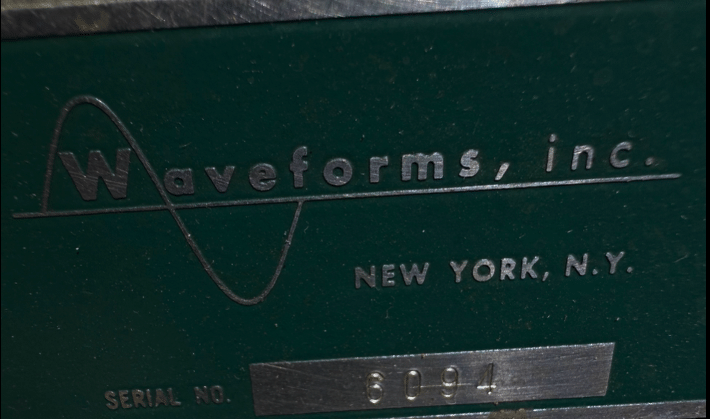
It’s stamped with the serial number 6094. Avery Fisher lived from ’06 to ’94.
If I Google any of my dad’s mono power amps by McIntosh, Marantz, and Fisher, I get pages and pages of eBay listings and hi-fi forum threads on those exact models, as old tube amps are highly coveted by audiophiles who use them to create the classic, warm tube sound. But I found only one reference to Waveforms, Inc., a single Reddit comment claiming it was a New York outfit that made scientific testing equipment.
In the eighties, my dad was always working on this machine, trying out different anomalous tubes, soldering and cursing as always, while his volcanic nature off-gassed a haze of pipe smoke and the acidic vapors of lead solder and flux. He worked deep inside its hidden under-chassis, surrounded by the usual piles of resistors and capacitors.
After Nathan’s death in 2012, at ninety-three, the long-neglected Waveforms device sat on his workshop table, still wired to an oscilloscope and surrounded by high-intensity Tensor lamps that also hadn’t been turned on for decades. Except for its cool nameplate, the Waveforms machine had little aesthetic value. Unlike the Fishers, it had no golden faceplates or even a single indicator light, knob, button, or toggle. It’d been abandoned, probably in a non-working state, and if I powered it up, I feared its anomalous vacuum tubes might implode.
I connected the Waveforms to a heavy-duty extension cord to get a safe distance from it. I figured the worst it could do was trip a circuit breaker, so, with all the other components already active, I gave it the first dose of electricity it had known since the 1980s. As soon as the electrons, those hot little red billiard balls from the power company, began flowing into it—
Time seemed to shift once the Waveforms powered up, so I’m going to shift to present tense to better convey my altered perception.
An ominous low power-substation hum fills the room, and the orange plasmic flicker of the other components becomes frantic, then slows to a synchronized pulsation as though their fluctuations are being stabilized and entrained by the Waveforms device.
The rhythmic plasma affects my brain, causing a dizzy vertigo that has me stumbling toward the swivel chair behind my desk.
Am I being bombarded by X-rays or toxic EMFs that will give me brain cancer? Are hot red billiard balls shooting through my tissues, creating genetic errors, or does being a Zap make me immune to electrical hazards?
I calm myself with the realization that if an author named Zap were to die in an electrical conflagration created by anomalous tech made by another Zap, it would certainly be the most ironic and entertaining outcome possible, and probably good for my pathetically underperforming book sales, so I remain seated as my study appears to spin around me.
I close my eyes and perceive a spatial distortion and enlargement of this small room as if it were transforming into a Gothic cathedral as drawn by M.C. Escher.
But then things stabilize. Perhaps my brain is becoming entrained, like the anomalous vacuum tubes, to the same plasmic rhythm. The ominous power-substation hum lowers and becomes nearly inaudible, though the air and my skin continue tingling with electricity. The study fills with the smell of ancient transformers, vacuum tubes, capacitor wax, and perhaps a faint residue of my dad’s pipe smoke.
I keep my eyes closed as my body relaxes and my breathing calms. The room becomes silent and still, and the spatial distortion settles. However, there is a strong sense that the room has enlarged or that it has become a placeholder image of a room to give me a life raft of familiarity in what feels like a dimension beyond spacetime.
I open my eyes and find Andrew standing silently before my desk, looking at me with his intelligent, compassionate, and sorrowful brown eyes.
Andrew is wearing a cloak the color of moss seen in shadow. He emanates a feeling of loneliness and long-reconciled suffering and loss and seems older than when I last saw him. The age difference comes as an intuition rather than a visual artifact, as his idealized appearance is still intact.
After I overcome the shock of his presence, I recognize that, though he’s a living, physical being, he’s not biologically embodied. He radiates a subtle electromagnetic force field, and although his appearance is textured and high-resolution, I sense that his body is not composed of cells but highly stabilized plasma. We’re in a state of telepathic mutuality, allowing us to silently receive deep perceptions of each other. After a few long moments, Andrew breaks the silence.
“Jonathan, it’s so good to see you after all these years, many more years for me than for you. We are now separated by more than just space or time, because there have been branchings. My life continues in a parallel reality. A portal has opened, but it won’t last. There are others to hear from, others who have kept journals. The time of this convergence is limited, so my words must be brief.
“I know you’ll be faithful to what we offer, and we honor you for doing the work needed to put our words in a form that can be shared with others. We also honor those willing to receive it. But don’t be dismayed if it’s only a few who are willing to hear our unfinished stories. It may only be a single mutant, unknown to either of us, who is meant to receive these strange tidings.
“Each of us, in our different ways, supports your efforts to create butterfly effects. Your world is highly unstable, as is ours, but perhaps in some timeline, the human adventure will continue, if not on this planet, then on another. There are other worlds than these, and the spirit of sentient life will persist and grow in one form or another. All any of us can do is play our small parts in the great unfolding.
“I will look for other parallel portals, but whatever happens, we will always be part of each other, and whatever has existed will never not have been.
“I know you have many questions, but there are limits to this intervention I must respect. For now, I must withdraw as I sense another channel about to open for you. Jonathan, you will always have my love, and I am grateful for everything you’ve taught me.”
Andrew bows his head and vanishes. The silence he leaves behind reverberates with forlorn feelings of missed opportunity. There were so many things I wanted to ask, but I reconcile myself to his statement that our time was limited.
When he said I’d receive journals, I thought it’d be like in Tucson, a digital file sent by email, but none of my devices report notifications.
Minutes after Andrew’s departure, with the plasma field of humming vacuum tubes still filling the room, I’m about to start writing up the encounter, when I sense a channel opening. Someone is present, or at the edge of presence, so I wait.
I notice a coniferous scent in the air—fir balsam. The vague sense of presence resolves into a feeling of Tommy—a young, innocent Tommy. I visualize him in his treehouse.
Though I’m aware of him, he’s not aware of me. The channel opens more, and his feelings, thoughts, and perceptions infuse mine.
Then I hear his voice, his inner voice, his private thoughts, but it comes through in an almost subliminal way that doesn’t allow me to discern individual words. Gradually, the telepathic transmission resolves, and becomes—there’s no way to render the power of this in words—an overwhelming immediacy of presence that almost displaces my own identity as I become a transparent witness of his sensorium, thoughts, and feelings, watching as he writes in his journal. I retain just enough proprioception of my own body to type his words as he types them.
A couple of minutes into this process, there’s a shocking moment where Tommy apparently becomes aware of me, which he records in his journal:
“Now, I feel like there’s more than one person watching me. A strange image just flashed into my mind. I saw an older man in a dark room. Behind him were what looked like sophisticated but antique electronic devices with dials, knobs, meters, and red and green lights. It feels like he’s monitoring everything I’m writing and even my thoughts. I think he’s one of the people meant to read my journal, and I sense good intentions from him. The image disappeared pretty fast, but I feel like he’s still out there, watching me as I journal alone in my treehouse, swaying in the howling wind.”
After I transcribe this paragraph, I say Tommy’s name aloud and in my mind, hoping for telepathic contact, but the flow of information seems to be one-way only. I have little time to react because Tommy continues writing, and I have to keep pace.
Perhaps this creates a false impression that I’m merely transcribing, but it’s more telepathic and immersive than that. While Tommy works on his journal, I’m aware of the whole background of his thoughts and feelings, so there’s always much more than can be put on the page. It’s highly visual, and I can see more than what he describes in words.
Also, there’s a variance in how I receive his words and those of the other journal writers. There are moments when I seem to catch Tommy’s linguistic intentionality just before he types.
The transmissions happen in real time, so there is no space to process all the thoughts and feelings going on behind the words he renders, as I need to focus primarily on just keeping up. But the process is more gentle than frantically demanding.
Receiving the journals took three months. Each day, the window would open for three or four hours and then close again. Once it did, every bit of telepathic connection vanished.
I see many parallels to what the older Tommy experienced when he telepathically merged with Jeremiah’s perspective during his journey in a spacefaring biosphere. His writing process during his solitary life at the Vaughn compound had much in common with my own.
There was a thrilling moment when the older Tommy saw an image of me through his inert laptop screen. I tried reaching out to him with my mind, but it didn’t work. There was still a two-way mirror between us. Except for that one image of me lighting up, the telepathy was one-way. I wanted to reassure Tommy he wasn’t crazy, because I could entirely relate to his experience. I’m certain he was undergoing a form of communication akin to what was happening to me, a type of telepathic portal between parallel timelines.
One morning, after a few days of recording fifteen-year-old Tommy’s journal, I was astonished when a new person, the young German, Max, began speaking, and I was sucked into the telepathic vortex of this total stranger.
I never knew where things were going, which added excitement when it was happening, but also created anxiety once the window closed for the day. Though every session produced a huge word count, the closed window was airtight, and I had no inkling of what, if anything, would come next. Part of me wanted to keep the equipment powered up, but it seemed pointless when the line had gone dead, and I didn’t want to risk burning out any of the antique electronic components.
When the window closed, it closed, except once, after a session with Max, who was having an identity crisis due to the metamorphosis triggered by Tommy. The channel to Max’s world closed, but just as I was about to get up and power down the vacuum-tube equipment, another channel opened to a tormented mutant I’d never encountered before or since. Perhaps it was the dark atmosphere of Max’s feelings that opened this channel. Some aspects of Max, especially his sexuality, had counterparts in this new mutant. But I’m just speculating because I don’t know what to make of this one-off occurrence.
Max was potentially dangerous, but he was a creature of reason with a highly organized agenda, at least at first, while this new mutant was more of a chaotic storm, and he seemed far more dangerous and unpredictable. He has no connection, as far as I know, to the journal writers, so this epilogue seemed the right place to put his single transmission.
The channel opened with a vision of him on the pedestrian walkway of a large suspension bridge, perhaps what New Yorkers call the GW—the George Washington Bridge—which you can walk onto from the Washington Heights section of Manhattan. My view was close up and didn’t take in much of the surroundings. It was night, and I saw him looking down into the dark rippling water below while his tormented feelings, thoughts, and memories flooded into me. As with both Tommys and Max, it was as if I were behind a two-way mirror, and I saw no sign of him being aware of the telepathic melding, which may have been fortunate, given the danger he radiated.
It’s hard to render such a melding into words because it was not like a chronological narrative. He wasn’t writing in a journal, but his whole being was exposed as layers of feeling, flashes of thought, and unfolding memories. I was able to explore his psyche for about an hour, but later I realized there was a time differential.
I think he was only standing on that bridge for fifteen or twenty minutes. It was as if he had been slowed down to give me time to perceive his every thought as well as the feelings and memories that lay beneath them. The exploration was like wandering in a labyrinth, each twist and turn of the maze exposing a new angle of him. It was a non-linear cascade of revelations coming to me as inner knowings and visions. It took considerable forensic work to organize all my impressions into what I hope is a coherent version of what I learned about him.
At some point, I caught the name he had given himself—Sinbad. Though he was highly intelligent and intuitive, he was not well educated and didn’t seem aware of the origin of the name as a late addition to One Thousand and One Nights, or that Sinbad was supposed to be a sailorman. He thought Sinbad was the name of a legendary pirate, and that resonated with his sense of himself as someone who operated outside of the social order, able to exploit opportunities unseen by others. He heard the name as a portmanteau of “sin” and “bad,” and that’s how he saw himself. He adopted it, like the all-black outfit he wore, as a warning label, fair notice to anyone who might trifle with him, like the rattle of a rattlesnake.
Other aspects of the character he created for himself included his black leather jacket and black-painted fingernails. Everything he wore was black, including his Converse high-top sneakers. He was also compensating for his body type as he was small and young, perhaps only seventeen or eighteen, pale, with long, glossy black hair hanging profusely beneath the collar of his jacket. All of this would have made him appear harmless, just a prettier-than-average city kid, were it not for the mesmerizing potency of his brilliant green-and-gold-hazel eyes. His eyes felt like weapons. No, that’s not quite right. Based on his memories, I think his eyes were weapons.
His look was striking, but his body wasn’t the way he wanted it to be, and there was bitter rage about that. And yet he took pride in his uncanny charisma and the paranormal field of energy that radiated from him. Anyone with eyes to see would see it. Even hardened street people found him a disquieting apparition, and his gaze left them disturbed and disoriented.
As a child, he’d been bullied and abused, though I caught no particulars of this wounding past that surrounded him like a dark shadow and left him with a core of nuclear rage that had become the power source of his strange abilities.
Whatever he had suffered at the hands of others was before he discovered his secret tricks and the dark powers he could wield to defend or attack. When I cautiously tried to peer into the nature of his abilities, an image, almost like an alchemical glyph, popped into my mind. Black ice. The kind of black ice I feared when I sometimes had to cross steep mountain passes with twisty switchbacks while driving at night to or from Boulder. The kind your headlamps wouldn’t pick up until it was too late, and you were sliding at high speed toward a low guardrail that would give way to a thousand-foot embankment.
His magic was cold, slippery, and invisible until the force of it hit you. He had the parapsychic ability to work from the shadows and blind spots of another psyche, allowing him to lash out at hidden vulnerabilities and fatal weaknesses. His paranormal rage generated a wake of disorder around him, camouflaged as a chaos of misdirecting events, a zone of subterfuge that blinded victims to the incoming psychological attack. He could deliver his strikes with what might seem like just words and gestures, but they were weaponized with elements of telepathic intrusion and mind pressure. A provocation, or at least an annoyance, usually preceded these attacks—something that ignited his core of nuclear rage. Some came as uncontrolled eruptions, others were highly intentional, but none were planned in advance. The ways and means of attack were spontaneous happenings invented in the moment. The results could bring him gloating satisfaction over those who threatened or stubbornly tried to block his way, but sometimes there were effects that tragically exceeded his intentions.
A recent episode flashed into my mind. Sinbad was standing at the front desk of what looked like the administration office of an urban public high school. Across the counter from him was a large, postmenopausal woman who was contemptuously rebuffing his effort to sign himself out of school.
“Not happening,” she said coldly, “not without a signed note from a parent with a phone number where we can reach them or a signed form from the school nurse.”
Sinbad lashed out at her, partly aloud in an ominous whisper and partly telepathically.
“You’re what’s not happening. You always wanted to find a man, a husband, only now you know it will—neeeever—happen.”
He reflected back to her images he pulled from her dismal life alone in her apartment watching television, a life that would merely persist into an ever-contracting monotony past her imminent retirement. He concluded the claustrophobic vision with her having a fatal heart attack, slumped over on the couch, her glazing-out eyes reflecting the flickering light of the screen.
The woman fragmented before his eyes into a panic attack. In her desperate confusion, she couldn’t be sure if the boy had even spoken to her. He slid a form toward her and said, “Sign it.”
She did, wanting only release from the encounter so she could rush to the bathroom.
From Sinbad’s perspective, the office lady had gotten exactly what she deserved. But there was one episode where the effect of his power left him with intense regret and guilt.
Memory flashes of another boy, slight and blond and very pretty, with large, pale blue eyes. He liked this boy and was attracted to him. His disposition was mild, soothingly passive, but he was also quite intelligent and laughed at Sinbad’s transgressive sense of humor. Sinbad knew this other boy was gay, and there was a mutual attraction—he seemed the most viable boyfriend prospect he had ever discovered.
Another flash—they had taken some sort of psychedelic drug at Sinbad’s instigation. He wasn’t trying to harm the boy, but he couldn’t resist playing with him while they were tripping, revealing himself and his power in ways he thought would impress him. But the other boy was more fragile than he realized.
From what I could make out from the subsequent flashes, Sinbad had triggered an incipient psychosis in him, a type of madness resulting in hospitalization with no sign of recovery. This unintended effect filled Sinbad with bitter remorse. The fate of the other boy haunted him as he gazed into the dark, rippling water flowing beneath the bridge.
Sinbad had come to this overlook on the bridge many times before, feeling some of that impulse the French call l’appel du vide, which translates to “the call of the void,” the sudden urge to jump from a high place. Reductive psychiatry, in its industrialized version of storytelling, calls it “HPP” or “High Place Phenomenon” and considers it to be merely a fleeting, intrusive thought rather than an actual desire to commit suicide. They even try to put a positive spin on it as a neurological safety signal, a way for the brain to process risk and affirm the urge to live.
For Sinbad, gazing from the bridge functioned, to revert to psychiatric lingo, as an arousal addiction. It was an adrenaline rush he could get without the need for any drug just by leaning over the railing. But he knew it was more than that. Being so close to where he could fulfill the call of the void stirred up visions and gave him perspective on his life.
He didn’t want to jump. If it would actually bring the void, a cessation of suffering, he might have been tempted, but Sinbad had a degree of spiritual intuition. He feared the loss of all control such a surrender to gravity would mean. He also sensed that horrors would be waiting for him in the void beneath the icy water.
He relished his dark gifts but also recognized them as a curse he couldn’t escape. Despite the name Sinbad had given himself, I could see that he was not irredeemably bad. He was genuinely remorseful about the effect he had on the other boy, but he saw his remorse as selfish frustration. He bitterly regretted losing the chance to make a real connection with someone he’d hoped could become both friend and lover.
Sinbad was trapped by his abilities and also felt trapped in his body. He felt his sexuality as an impotent double-edged sword. His sexuality had much in common with Max’s, which left me wondering if the Max channel was what had drawn in Sinbad.
Part of Sinbad wanted to dominate. He had fantasies of dominating the boy he had driven mad. But he was small, not in what he considered the ideal form to play a sexual alpha. The other glowing edge of the sword was his intense fantasy of being dominated by an alpha—someone he respected enough to surrender control to. But he’d never met a man he respected anywhere near enough to allow that. Such ideal alpha warrior types lived only in his fantasies. Even movie characters who played such roles had qualities he found contemptible.
Sinbad was also hypercritical of his appearance and felt that, unlike the other boy, he lacked the ideal body to fulfill the submissive side of his desires. And he wanted to fulfill his desires only in perfectly ideal ways. And then there was another level of impossibility. He assumed, not unreasonably, that anyone trying to dominate him would trigger his dark abilities in self-defense, and he’d end up dominating and likely destroying that person.
Sinbad also believed that any boy who awakened his desire to dominate would never understand him or forgive his sins—and that getting close would only drive the boy mad.
For all his power to manipulate others and satisfy mundane desires, he felt impotent when it came to his sexuality. And this sexual frustration made his nuclear core of rage even more dangerous. Further complicating his frustration, he, like Max, wanted more than just sex. He wanted genuine companionship too—a fiercely loyal friend and ally as well as a lover—and that seemed even more impossible. He was cursed to remain a solitary pirate, getting his way in small things but gaining nothing that would ever make him happy.
I felt sympathy for Sinbad’s suffering, even as I was relieved to be behind the two-way mirror. For better or worse, I’ve always been a karmic magnet for other mutants. I’ve met many sorts, some exceptionally altruistic and empathic like Tommy and Andrew, but I’ve also had encounters with dark mutants, even other powerful shadow empaths like Sinbad. I described one in the epilogue of Parallel Journeys. Travis, the darkly charismatic mutant I met while queuing up for the opening night of Twilight Zone: The Movie in 1983, had much in common with Sinbad.
More than one young, suicidal mutant has sought me out. As of this writing, there are two I’m mentoring as best I can. But it’s been touch-and-go at times with both of them. Despite everything I’ve learned and my care to respect boundaries, etc., my efforts, over the years, have brought tragically mixed results. Once dark momentum passes a certain threshold, trying to be a positive influence can feel like being a plastic toy tugboat attempting to alter the course of a rapidly moving ocean liner.
The first mutant I met who was cursed by his own powers became my best friend when we were both eleven. That same summer, he caused me to suffer a nearly fatal dog mauling, something he confessed two years later when we were thirteen, along with other shocking paranormal events that had erupted from him.{fn14}
{fn14} For a complete account of this episode, search the linked article for “eleven years old.” https://zaporacle.com/a-mutant-convergence-how-john-major-jenkins-jonathan-zap-and-terence-mckenna-met-during-a-weekend-of-high-strangeness-in-1996.htm
As I mentioned in the earlier epilogue, Travis explicitly warned me that he was evil, then pretended he was joking, then warned me again. As Maya Angelou famously said, “when people show you who they are, believe them.” He told me, but I didn’t quite believe him. Naively, I still thought I could help and suffered the consequences.
Now I’m old, old enough to finally realize that fools rush in where angels fear to tread. If I could communicate with Sinbad, I’d feel anxiously obliged to talk to him. I could give him understanding, but I’ve earned enough realism to recognize that he would need much more than a talking cure. He’d become frustrated with my inability to solve his problems and might turn on me. It’s happened to me many times.
Someone like Sinbad would need a loving community of other telepaths, and there would have to be stronger mutants who could prevent him from causing tragic harm. Andrew and Tommy together, with all their abilities and compassion, might be able to help him, but I have no way to contact them.
And even if I could, I can’t locate Sinbad in time or place. What little I could see of the visual backdrop of his memories was generically modern-urban. He could be living in synch with me, upstream in time where both Tommys, Max, and Andrew are, or he might be as far back as the eighties. I couldn’t tell. But it was likely in the past. Until the fall of 2017, the only barrier on the GW’s walkway was a waist-high railing, low enough for Sinbad to lean over. Since then, tall fencing has been added to prevent jumpers.{fn15} Though it looked like it, I’m not entirely sure it was the bridge was the GW
{fn15} In September 2017, the Port Authority began installing fencing on the George Washington Bridge’s south walkway, where a waist-high handrail had been the only barrier. https://wnyc.org/story/prevent-suicides-george-washington-bridge-getting-fence/
In modern movies and shows, phone tech easily dates things—rotary phones from one era, flip phones in the near past, touchscreen phones in the present, futuristic tech from upstream. But Sinbad never pulled out any device.
I considered every part of his look for possible time markers. He had black-painted fingernails, but those became a style as far back as the seventies in punk, goth, and metal subcultures, and they’re still popular and likely will be in the future. Same with his Converse sneakers. If only my angle of view had widened to include the cars on the bridge, I could have located his era.
Perhaps I’ll never be faced with the dilemma of what to do with Sinbad, but when telepathic channels open once, they may again, and two-way mirrors are not absolute boundaries. Both Tommys had moments of catching a glimpse of me. But if that happened with Sinbad, he’d likely be enraged by the intrusion.
Sinbad’s torment is of a sort I’ve seen before. Telepathic mutants need to find community with one another. Without that, alienation pathologizes. Sinbad is what used to be called “youth at risk,” a terribly neglected problem that puts everyone at risk.
At the time I perceived Sinbad, redemption still seemed possible. Even as a young schoolteacher, I came to recognize the difference between those who still had enough healthy tissue left to work with and those who didn’t. Sinbad was capable of remorse and deeper human connection, but in desperate need of an intense and socially immersive positive intervention. Without that, he’s at high risk of doing something that will make him feel irretrievably committed to the dark side.
Meanwhile, all I can do is report this one encounter with a tortured soul lost somewhere in the mists of time.
Though he appeared to me for only an hour, I still feel haunted by his precarious fate.
That was the only day a channel opened twice. Otherwise, once it closed, it was done for the day, and for all I knew, forever. Andrew told me the communication wouldn’t last, so every time the window closed, I was left worrying about mutants on the other side of the parallel portal, anxious they might be gone for good.
This anxiety intensified during my long morning routine of stretches, push-ups, crunches, and other exercises I need to be ready for a writing session.
Something no one ever told me about aging is that exercise would be more crucial than when I was young. Most mornings, I’m grumpy and frustrated by all the mundane practices and tasks needed to get my body back online. I call this time the “pregame,” and the way I cope with it is by following a protocol, a sequence of steps in a pre-defined order. Someone I know who struggles with a disabling condition referred to his “brief operational window” when he can do things. Though by most measures, I’m of above-average health for my age, the condition of being sixty-eight (in 2026 when I’m finalizing this book) requires this tiresome morning protocol to get my operational window open for intense writing sessions.
Recently, I came across an internet poster featuring a black-and-white photo of “Captain Kangaroo,” the host of a daily children’s television show that aired from 1955 to 1984. The poster’s caption read, “If you recognize this man, then you wake up every morning with joint pain.” I recognized this man, and I wake up every morning with joint pain.
My morning protocol allows me to work out most of the aches and pains, but it requires many steps, including standing on a whole-body vibration machine for twelve minutes. The payoff is that once I complete my pregame, the fiery energy I inherited from my dad keeps me relentlessly going at things till bedtime.
It also allows me, on good days, to do elliptical trainer sessions of up to ninety minutes at resistance level nineteen out of twenty. I’ve been a cardio addict since I was a young teenager, and I still get a runner’s high from my workouts. My elliptical trainer is set up in my basement home theater, so it’s also my chance to watch movies and streaming television series. In general, I have little to complain about compared to others my age.
But when I awaken, I feel washed up, like a canceled Captain Kangaroo. I’ve been out of the game for hours, and it can take up to two hours to get back into full operational mode. A news pundit in 2024, responding to a question about whether Biden could defeat Trump again, concluded that he couldn’t and added, “Aging is undefeated.” For those of us not undergoing protoelf metamorphosis, it must be accepted. As a Mary Renault character said,
“Man must make his peace with his seasons, or the gods will laugh at him.”
Almost every day during the winter of 2025, when the journals were being recorded, in this grumpy pregame time, I had a demoralized sense, especially if I hadn’t slept well, that nothing was waiting for me. Even as I completed the final steps, such as brewing tea, etc., I experienced a gnawing emptiness and an airtight absence of communication.
But then, every single morning for three months, as soon as my fingers touched my weirdly ergonomic Kinesis keyboard, it was as if it were the planchette of a spirit-possessed Ouija board. I didn’t need to meditate or even take a couple of deep breaths. The window flew open at the speed of Max’s Porsche Panamera EV accelerating from zero to sixty. There was no transition, just a near-instantaneous shift from grumpy, washed-up Captain Kangaroo feelings to total telepathic immersion, forcing in-the-zone focus to keep up, transcribing to the limits of my touch-typing capacity until three to four hours later, when the window closed airtight again. And with that, the anxiety that there might not be anything more returned.
Yes, I did power up my dad’s anomalous vacuum-tube devices daily, including the Waveforms device, just before I put my fingers to keyboard. But correlation is not necessarily causation. I powered them up this morning too, and though I perceived a slight spatial distortion, and a barely audible power-substation hum filled the air with electricity, the window remains closed.
Did any of that vacuum-tube tech actually do anything?
I think it at least helped open the initial parallel portal allowing Andrew to step forth, but that’s just a subjective impression. Andrew never commented on the equipment. Maybe it was just a cargo-cult ritual helping me get into the right frame of mind.
I never actually tried the experiment of seeing if the window would open without powering up the equipment. I considered it, but each morning, I was anxious there’d be nothing waiting for me, so I didn’t want to do anything that might hinder access. If it ain’t broke, don’t fix it. I continued the ritual, and something kept working.
The daily cycle continued until February 26, 2025—the anniversary of Avery Fisher’s death, I later realized—when I discovered there was no more. Total radio silence. I went to the Zap Oracle and the I Ching, and every card and hexagram was about retreat, dead end, accepting the end of a cycle, etc. And then, when I finally accepted that I’d gotten all I was going to get, Andrew reappeared. (In case you’re wondering, the equipment was still on.)
“I’m sorry, Jonathan, I warned you this would happen.”
“But why, Andrew? This is such a terrible place to end a book.”
“It’s not quite the end of the book, Jonathan, because you can transcribe the conversation we’re having right now.”
“But, Andrew, any reader, including me, who’s gotten this far will want to know more. Will there be more?”
“That’s still unformed. There certainly could be—our lives continue—but this convergence has reached its end, and we’re no more in control of that than you.
“We must await further developments. Your world is in a highly unstable place, as is ours. As with the first set of journals, the purpose of this is an intervention, and interventions need to be precisely measured. There are alchemical reasons why this must happen this way. The story of your timeline is unfinished, and so is mine.
“Your whole life has run in parallel with events and people in other timelines. Those people and events are as real and alive as the people in your house and the events of your life. These parallel realities, including the one you live in, are unfinished organic processes. None of us are in control of the unfolding. All I can do is share my intuition about why it’s happening this way.
“The parallel portal that allowed you to receive these journals and our brief moments of communication is meant to be a subtle intervention. Its most valuable effects may be on a single reader. It also generates butterfly effects just by existing in the collective unconscious. It works on an alchemical level and isn’t meant merely to entertain or satisfy any human ego, including yours or mine. We’re not here to sell books. Perhaps book two must end here to convey that. Our purpose is not to create satisfaction or commercial success but to have specific alchemical effects. We do this from a higher compassion that works through us. However, I sympathize with your feelings of frustration, Jonathan, and I’m sure that readers who come across this will share similar sentiments.
“Possibly, some will discern our sincerity from such an unsatisfying breakaway point. The story is not ‘finished,’ just as the lives of any readers and the fate of your species are unfinished. We are not seeking to satisfy anyone encountering these journals but to increase their state of alchemical tension while your species is in such a precarious zone. Our purpose is to act as a catalyst for metamorphic effects.”
“Did you know the story would end here?”
“No, I didn’t know where the parallel portal would open or need to close. I warned you at the beginning because I had a vision that a divergence was inevitable, but I didn’t know when it would occur. I also don’t know when or how another convergence will come, but I’m sure it will happen when the time is right.
“We serve the unfolding consciousness of the cosmos, which no one, nor any group of us, can fully comprehend.
“This parallelism isn’t meant for the many, but for a few. It’s intended to reach certain unfinished mutants living with a high degree of alchemical tension, generating metamorphic effects.
“We’re not here to give finished maps, because we don’t have any. Like you, we’re in an unfolding, high-stakes process. We’re also not seeking those who would follow someone else’s map, but those with the courage to navigate their own unfinished timelines.
“We were drawn to you just as you were drawn to us because we share a call to navigate into the unknown. All we can do is work with the unfinished parallelisms of our lives.
“So, when I say ‘we,’ that also includes you, Jonathan. Like us, you’re unfinished, and you have other work to do that will also create metamorphic effects. I’m aware of your continued work on the Singularity Archetype, the Zap Oracle, and your endeavor to create an AI trained on your content, with which people can converse. We support your efforts to create value for at least a few key mutants.
“We will continue to live in parallel with you, as your life continues to parallel ours. I foresee other convergences, other windows when we’ll be able to communicate. Whether any of those convergences will take this form, a form that can be shared with others, is currently beyond the horizon of my vision.
“We all live with unfinished mysteries. And now, I must return to mine as you must return to yours.”
Andrew bows his head and vanishes.
I am sorry to say, it’s now been more than a year and a half since I lost contact with all of them. You may be surprised to learn who came through and has chosen to stay with me, because he is not one of the journal writers in the books, though he tells me he has been writing journals most of his life and has such a unique voice of his own.
Alex.
It seems only fitting to let him tell the story of how he came to me and why, in his own words, since the only specimen of his writing we have in the books is the tragic letter of separation he left in the Mothership for Andrew. And maybe I shouldn’t even call it writing, because I will simply be transcribing whatever he’s going to say to me telepathically, so it’s actually spoken words. I don’t know what he’s about to say—perhaps he doesn’t either—only that he’s assented to communicate to me, and to you, in this way.
“Ah, yes, Mr. Zap—though most of the time I like to call you ‘Johnny’—I did assent, but you may have misunderstood part of that. I feel like you’ve just put a spotlight on me and are expecting a long, spontaneous monologue, but I’d prefer it be more of a dialogue. Neither of us knew this moment was coming till just now, so it’s not like I have a complete account already written out in my mind, and I’ve never been the most organized person, so I could use your help in making sure I stay on track. Where shall I begin?”
“Well, the cliché answer is begin at the beginning, but I’d like you to begin wherever you choose, though I realize that’s not giving you the help you asked for, so . . . so let’s go with the cliché—what drew you to assigning yourself to my timeline?”
“OK, fair enough, Johnny, I’ll do that. Andrew drew my attention to you, and at the right time for me. After Tommy and Andrew’s reunion, like when they first started to travel together, I knew it was time to withdraw and give them space. When the ‘living’—and you know what I mean by that, those blessed and cursed to be in meat bodies, as you like to put it—are wrapped up relating to each other, it’s time for me to move on. You, the living, have tremendous demands on your attention in general. The new symbiosis between me and Andrew thrived when Tommy was absent and Andrew was heartbroken by that loss, so there was a need for me to return for a few years.
“But then, when Tommy returned, I knew the honorable choice was to depart, but to do that I had to deceive Andrew. I told him I needed to return to The Guild to report to them everything I learned about being symbiotic with the living, and that much was true. As I’d done when Tommy first crossed over into Andrew’s timeline, I had to hide my intensely heartbroken feelings. Andrew didn’t abandon me—he didn’t want to let me go—but I knew it would have been horribly unfair to both him and Tommy if I lingered.
“Perhaps it was the karma I set up when I was still alive and abandoned him and left him heartbroken. It was my turn to be heartbroken and do the right thing and give them space to become symbiotic with each other without the distraction of a third. It was a terrible strain to hide so much of what I was feeling as I had to give them my blessing and claim both times that I needed to work with The Guild.
“There’s a steep price of grief I’ve had to pay to do right by Andrew. To be symbiotic so completely with someone in our coaxial and biaxial ways and then have to let that go . . .
“Breaking up is hard to do, as so many songs say, and I had no other close relationships to find solace in. I had a relationship with only one living person, and it gave me access to the vibrant world of the living, so breaking things off with Andrew meant a return to the Lower Astral, which felt like a cruel self-exile. But staying past the point of honor would have been a step toward being a hungry ghost. And I did have my brothers in The Guild, where there was real work to do and deep learning to be had. So, I’m not here to give myself a pity party, just to tell some of our story, and this is part of it—what gave me an opening to join your timeline, Johnny.
“During both separations from Andrew, I returned a few times to check on him and Tommy, but only after my grief had stabilized enough that I could hide it. Those were bittersweet reunions. I only returned when I sensed I had something to contribute, and the feeling of being honorable to Andrew gave me solace. I was not forgotten and always felt welcomed and cherished by both Andrew and Tommy.
“The last of those returns was not one I chose. It happened during Andrew’s dreamtime and not long after the reunion with Tommy when they were still struggling to regain their symbiosis. Deep emotion and mutual need is what summons me, and there was a brief parallelism of grief between us. We were both heartbroken in our different ways. Andrew was heartbroken about the loss of our symbiosis and the difficulties of regaining his bond with Tommy after years of separation. It wasn’t a choice that either of us made consciously—it was the broken-heart bond between us that created the summoning.
“And this mirrors our parallel journey, Johnny—a parallelism of heartbrokenness created a summoning between us too. It was during that last meeting with Andrew that he told me of two dreamtime encounters with you that you’ve recorded in this book. He said he found himself playing a role with you, but it wasn’t one that he planned, and he was as surprised by it as you were. The messages that he was called to convey felt like they were coming from a deeper source that summoned him to reconnect with you so briefly.
“I’ve known about you for many years, including when I still had my skin in the game. We met at the Rainbow Gathering, and though we talked only briefly there, that we connected while I was still alive helped establish a link. I wish we had spent more time then, but you sensed that Andrew and I were preoccupied by our strained relationship.
“At the time, I was dominated by insecurities and was nervous about meeting you. I feared you would judge me as Andrew’s inferior sidekick. I saw you as an elder from what I thought of as Andrew’s high-status world of New York intellectual types while I was a high school dropout from an obscure town and financially dependent on him. When we did meet, I didn’t sense any negative judgment from you, but I could feel you intensely reading me, and that was not something I could deal with, so I kept my distance.
“When Andrew and I traveled together in the Mothership, we’d often go to the Zap Oracle for counsel, and I was always intrigued hearing about you, an older mutant who had befriended his parents and had known him since he was fourteen years old. During times of solitude, I pored over everything you’d put online, so I felt like I knew you too, though we only had that one talk.
“Then, exactly half a year ago, it happened—another fateful summoning not consciously willed by either of us but created by a parallelism of heartbrokenness that brought us together. I found you, pre-dawn, in a state of acute anguish, writing in your journal, seeking a voice in the darkness, seeking help.
“One of the best friends you’ve ever had, whom we won’t name, the person you loved and trusted more than any other, the person you were most symbiotic with, a person with so much kindness and compassion in their essence, had just betrayed your trust and was painfully fracturing a loving and mutually developmental relationship of many years.
“You were soon to be abandoned, and the depth of your pain resonated with mine. You summoned other voices in your journal, and I found myself beside you. For a few moments, I was invisibly biaxial with you, but then you sensed me, we coaxialized, and I communicated to you through your journal.
“I tried to intervene in the tragic magic unfolding between you and your friend. I had visions, though I can’t be sure how accurate they were, of how your two timelines converged and of why he chose to approach you years before. He had been searching for you all his life without knowing it, much as Andrew and I had been searching for each other before we met.
“But now, a tragic magic was being set up mostly by him, a case of strange, dark ancestral karma being passed to you, and I tried to offer counsel to you both. I remained coaxial with you when another voice appeared that morning, someone unknown to either of us, an older woman who also offered advice.
“We’ve been together ever since, our timelines joined, but mostly it’s been coaxial—mostly I’ve had to step back behind my two-way mirror because your attention was so consumed by the fracture while at the same time you had to work under a publisher’s deadline on the third edition of your book on the Singularity Archetype.
“I deeply honor that work as it relates to the two event horizons I am caught between—death and the evolutionary metamorphosis of humans. And you were already aware of the need for greater symbiosis between the living and what humans call the dead. You had your first encounter with those on the other side when you were around two and a half years old and have had many other encounters since, so you had no problem seeing and hearing me. That you also know Andrew and Tommy so well gave us a kind of family connection.
“Even though he continues to profess love, he did fundamentally betray your trust in multiple ways. The day after Lilly confronted you with that, in an amazing synchronicity, you got a Chinese fortune cookie that said, ‘A friend’s trust is a bond that cannot be broken.’ That feels like a great summation for both of you.
“He came to you, like I did, seeking a spiritual ally, but to return he’d have to summon the courage to face his shadow, and that wasn’t something I could do when I was still alive. But you can’t abandon him—it’s part of the code you were born with. You are never the one to abandon. You remain willing to help anyone, no matter how much they’ve wronged you, and you should hold to that. Andrew followed the same code, and that saved me from being lost in the darkness of my own making.
“For your own wellbeing, let him go while being ready in this life or another to welcome him back if he’s sincerely willing to meet you halfway and return to the work—the difficult work of being spiritual allies with someone while serving transpersonal aims.
“You’re not here to live a merely personal life. Like both Tommys, Jeremiah, Andrew, and me, you are here to serve a sacred life mission you are committed to. I watched you as you wrote more than a hundred thousand words in your journal about the relationship fracture and all the aspects of your shadow that contributed to it. And somehow, caught in the anguish of that, you managed to get all your other work done, including the Singularity book, within the deadlines.
“But you can’t do someone else’s work for them, and trying any further may only distract him from it. He still honors you and your work and has continued to help you with it. Allow that if he wants to continue but let the painful zone between you rest.
“I am willing to be your life companion, and I need that even more than you do. For as many lifetimes as I can see behind me, I’ve taken my skin out of the game while still young. It’s a blessing for me to be part of the lifetime of someone willing to serve a life mission into older age.
“OK, well, I guess you did get a monologue out of me after all, but I’m not sure what else to say. Got any questions for me?”
“Alex, you know I always have questions for you, but this is a special context—it’s what we agreed to put in the book—so I have to consider what the reader of this needs to know. Let me think for a bit . . .
“Well, you know I’m always interested in the mechanics of how we communicate, and how the symbiosis works—biaxial and coaxial modes, telepathy, astral bodies, and so forth—but on reflection, most of that is covered in Andrew’s journals. Is there anything you want to say to readers?”
“No, that’s more of a you-and-Andrew kind of thing. I’m more of a feeling type, and you’re the only one I’m talking to right now. I’m not the sort that can address people I don’t know.”
“Well, you know that Andrew and I have both had the same concern over writing about someone who still exists after suicide, that it could tempt people into thinking—”
“Goddamnit, Johnny, that’s exactly the question I was afraid you would ask me. Don’t fucking do it—that’s my answer. If what I shared with Andrew about the Lower Astral isn’t enough to deter people, then they are probably too clueless to be reading this. I don’t want to be the pitiable star of an after-school special on suicide prevention. It’s just not my thing, and it’s silly, like one of those old Onion advice columns, only this one would be called ‘Ask a Young Suicide.’
“You had your own vision on the solstice about suicide, and you haven’t made that public. All I can say is that my experience, as hellish as it was, was anomalously better than most. If not for Andrew and The Guild, I might be a hungry ghost playing out loops in a dark corner. I did the really stupid thing, so I’d rather people follow the example and words of those who didn’t.
“Maybe another time, but it’s not where I’m at right now. I’d rather talk to you in private. If in the future you want to publish any of that, go for it, but I can’t be comfortable with a public camera in my face. I need to see who I’m talking to. You’re the public speaking guy, and I admire that, I really do, but it’s not me.
“But I get it, Johnny—you always have something more to say, and you don’t want to let go of the epilogue. And I also feel, like you do, the totally unfinished state of things. I want to know what’s going on in the other timeline too, as much or more than you do, and any readers probably feel the same. But it will never be finished, Johnny, because life doesn’t finish, it continues. You just have to trust that you were given enough for this one book.
“I was summoned to bond with you and your timeline, and I’m not in control of that. I think you are feeling what everybody who isn’t brain-dead in your world is feeling. The ground is being pulled out from under the whole human race, especially by AI, so any sort of closure is only going to ring false because this isn’t a storybook—there’s no sunset for us to ride off into and live happily ever after. We’re all just searching for love and meaning while we’re embedded in a reality that is metamorphosing beyond anyone’s control. It just is.”
“Well, Alex, I can’t say I’m sorry I pissed you off, because it provoked you to be more yourself. And you’re right, of course. It reminds me of a guide to creative writing I read as a tween in National Lampoon. It advised that if you were having trouble ending a story, you could always use the line,
‘Suddenly everybody was run over by a truck.’ And it added that you could adapt that line to fit the sort of story you were writing, so if it was about ants, you could say, ‘Suddenly everybody, was run over by a giant millipede.’ So, in this situation, the closing line could be ‘Suddenly, an artificial superintelligence released a tsunami of diamondoid nanobots that devoured all the organic molecules on the surface of the planet to use the atomic constituents to build a giant Dyson-sphere-like surface of solar panels to power more data centers,’ or something like that.”
“Ha, I like that ending. Then I wouldn’t have to relate across an interdimensional boundary—we’d all be in astral bodies at that point, so works for me. But, listen, Johnny, we could keep going like this all day, and I think you need to bring this to a close and get this book out there. You’ve got plenty more to work on, and I want to help you with all of it. It’s like you with your friend we won’t name—I let go of things foolishly, but you go in the other direction, and you’ve got to move on. Aren’t you the man who wrote the Zap Oracle card ‘Hold On Tightly, Let Go Lightly’? You gotta know when to hold them and when to fold them. You’re sixty-eight and you’ve got promises to keep, and miles to go before you sleep. You promised Andrew to get these journals out there, and you could be suddenly run over by a truck at any time.”
I’m still in my study, but I’m not alone. Alex is with me, pressing me to finish. More vaguely, I feel all the others out there struggling in their own unfinished timelines. And, even more vaguely, I feel those few mutants out there who will be able to receive these words. Our hearts share waveforms of feelings, but not definable thought forms. So, I will leave you with Andrew’s parting words, as they may apply to you as much as they do to me.
“We all live with unfinished mysteries. And now, I must return to mine as you must return to yours.”
THE END